
Online Quran Classes For Kids Including..
I’ve been teaching Quran to children for years, and I still get the same message from parents almost every week. It usually goes something like: “My child is seven — is it too late to start? I don’t know where to begin.”
It’s never too late. And honestly? Seven is a great age. But searching for online Quran classes for kids and actually knowing what to look for — those are two very different things. There’s a lot of conflicting advice out there, and most of it isn’t written by someone who actually sits with children every day and watches what works.
So let me give you what I wish every parent received before their child’s first class.
At What Age Should a Child Start online Quran Classes?
Parents ask me this constantly. My honest answer: it depends less on age and more on the child.
That said, here’s what I’ve seen in practice — not in theory.
Signs of Readiness (Ages 4–6)
A four-year-old can absolutely start, but don’t expect structured reading. What you’re doing at this age is planting seeds. You want your child to hear Arabic letters, repeat sounds, and feel comfortable with the rhythm of Quranic recitation. That’s it. Don’t push further than that.
The children who thrive at this age share a few things: they can sit still for maybe 15 minutes without melting down, they enjoy repetition (songs, rhymes, the same story read seven times — you know the type), and they respond well to a warm, patient adult who isn’t their parent.
That last part matters more than people think. Some children are fine learning from mum or dad. Many aren’t. There’s a dynamic that shifts when a teacher enters the picture — suddenly it’s “real” in a way home practice isn’t.
For this age, the Nour Al Bayan Course is where I’d point you. It’s phonics-based, gentle, and designed specifically for young beginners who have never seen an Arabic letter in their life. Sessions run 20–25 minutes — no longer, I’d say, for a five-year-old. Most parents who enroll at this stage find that online Quran classes for kids this young work surprisingly well, precisely because the one-on-one format removes any classroom pressure.
Structured Learning (Ages 7–12)
This is genuinely the best window, and I don’t say that just to be reassuring. Children between seven and twelve are wired for language in a way adults aren’t. They pick up sounds without overthinking them. They don’t get embarrassed when they mispronounce something. They’ll just try again.
By age seven, most children can handle 30–40 minute sessions three times a week. They can track progress visually — which letters they know, which Surahs they’ve completed — and that sense of movement keeps them motivated.
The Noorani Qaida Course works beautifully for this group. It takes a child from zero Arabic knowledge through letter recognition, vowel sounds, Tajweed basics, and eventually to reading Quranic text — all in a structured 12-week framework. I’ve seen children finish it and genuinely surprise themselves with what they can do.
Teen Learners — A Different Approach
Here’s where I want to push back on a misconception. Parents sometimes come to me apologetically: “I know it’s probably too late, she’s 14…” — and I have to stop them right there.
Teenagers often progress faster than younger children once they commit. They understand explanations. They can self-correct. They have more context for why it matters.
What changes is the approach. A 14-year-old doesn’t want to be treated like a child who needs stickers and praise for getting through a lesson. They want to understand what they’re reciting, not just parrot it back. Pairing Quran reading with even a little bit of meaning — why this Surah, what this verse is saying — makes a profound difference for older students.
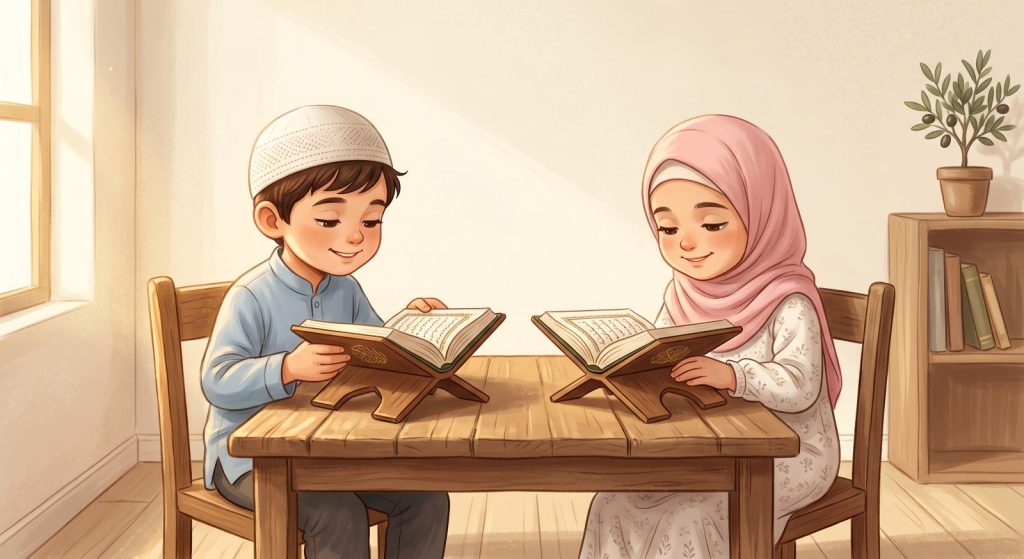
What to Look for in an Online Quran Classes for Kids
I’ll be direct here, because I’ve seen parents get burned by making the wrong choice and losing months of their child’s time.
Qualified and Certified Teachers
An Ijazah isn’t just a piece of paper. It means the teacher learned from someone, who learned from someone, going all the way back to the Prophet ﷺ. That chain of transmission is how the Quran has been protected for 1,400 years — and it’s how you know your child is learning correct pronunciation, not whatever a non-certified teacher happens to remember.
Ask any academy: Do your teachers hold Ijazah? Can I see verification? If they get evasive, that tells you something.
Female Teacher Options
This isn’t a minor preference — for many families it’s non-negotiable, and rightly so. At Nour Al-Huda, we have qualified Ustadhat available for all courses. It’s not an afterthought here. If you need a female teacher, say so when you book the trial and we’ll match your child accordingly. No awkward conversation required.
Class Length and Frequency — by Age
This is something I feel strongly about. Too many parents push for longer sessions thinking more time equals more progress. It doesn’t work that way with children.
Age | Session Length | How Often |
|---|---|---|
4–6 years | 20–25 min | 2–3x per week |
7–9 years | 30 min | 3x per week |
10–12 years | 35–45 min | 3x per week |
13+ | 45–60 min | 2–3x per week |
A tired, bored child retains nothing. Twenty focused minutes beats an hour of resistance every single time.
Which Course Is Right for Your Child?
This comes up in almost every parent consultation. Here’s the clearest way I can break it down:
Nour Al Bayan | Noorani Qaida | |
|---|---|---|
Best for | Ages 4–9, complete beginners | Ages 6+, ready for structure |
Approach | Child-friendly phonics, visual and audio focus | Systematic Arabic letters + Tajweed rules |
Duration | 3–8 months | 12 weeks (structured plan) |
End result | Comfortable with letters, early Quranic reading | Reads Quranic Arabic fluently with correct pronunciation |
Choose if… | Your child is young or never seen Arabic before | Your child is 7+ and ready to commit to structured sessions |
Both courses lead into the same place — confident Quran recitation. The starting point is what differs.
Not sure which to pick? The free trial class helps with exactly this. The teacher will assess your child’s level and recommend the right path. You don’t need to decide alone.
How Online Quran Classes for kids Work at Nour Al-Huda?
If this is your first time doing online Islamic education, here’s what the actual experience looks like — no surprises.
The Free Trial Class
This is a real class, not a sales pitch. Your child sits with a qualified teacher, the teacher gets a sense of their level, and your child gets a feel for how sessions work. It usually takes about 20–30 minutes.
What I’d suggest: let your child experience it without you hovering over their shoulder. Kids perform differently — often better — when parents aren’t in the room watching their every move. Be nearby, but give them space.
If the teacher isn’t a good fit for your child’s personality, say so. Getting the right match matters more than most parents realise.
One-on-One Sessions
At Nour Al-Huda, online Quran Classes for kids are live and one-on-one. I want to explain why this matters for children specifically.
In a group class, a shy child can go an entire session without actually being corrected — they just stay quiet and let others answer. With one-on-one, there’s nowhere to hide. That sounds intimidating, but in practice it means faster progress and a real relationship between teacher and student. The teacher notices when a child is confused. When they’re bored. When they need encouragement versus when they need a firmer push.
Flexible scheduling means you can find times that actually fit around school and family life. Check Plans & Pricing — options start at $20/month, which makes it accessible even for families just starting out.
5 Things That Actually Keep Kids Motivated in online Quran classes (From Someone Who's Seen What Doesn't Work)
I want to be honest here: motivation is where most parents and children struggle, not the learning itself. Here’s what I’ve found genuinely makes a difference.
1. Routine beats enthusiasm. Starting with excitement is common. Sustaining it is rare. What works long-term is treating Quran class exactly like school — it happens on Tuesday and Thursday at 5pm, full stop. When it becomes non-negotiable, children stop negotiating.
2. Let them hear Quran at home — not as background noise, but intentionally. Play a recitation during dinner. Ask your child: “Do you recognise that Surah?” Make it a question, not a quiz. Our Listen Quran page has complete Murattal recitations from Al-Husary, Abdul Basit, and Al-Minshawi — free to use anytime.
3. Don’t turn home practice into a battle. Parents sometimes try to drill children between sessions, and it turns into conflict. Unless your child’s teacher specifically assigns home practice with a structure, light and short is better than thorough and tense.
4. Acknowledge the small stuff. A child who correctly reads a new letter for the first time deserves real acknowledgment — not just “good job.” Tell them specifically what they did: “You got the Dhad right — that’s one of the hardest letters.” Specific praise lands differently than generic praise.
5. When motivation drops, talk to the teacher before you consider stopping. Every child goes through a flat patch. Usually something small shifts the dynamic — a new Surah to work toward, a shorter-term goal, a slightly different pace. I’ve kept many children in their Quran journey simply by having an honest conversation with their parent about what wasn’t working. Don’t wait until the child has fully disengaged.
For more ideas on this, the article 10 Practical Hacks to Make Quran Learning Fun for Kids is worth reading alongside this one.
Book Your Child's Free Trial Class
Online Quran classes for kids at Nour Al-Huda start with zero commitment — just a real lesson with a qualified teacher to see if it’s the right fit.
The right time to start is not when everything feels perfectly ready. It’s now — with a trial class that asks for nothing except showing up.
→ Book Your Child’s Free Trial Class
Every child who learns the Quran starts somewhere. One class, one teacher, one patient session at a time.
Nour Al-Huda Academy offers online Quran classes for kids and adults, Arabic, and Islamic Studies courses worldwide. Certified teachers with authentic Ijazah and Sanad. Female teachers available. Flexible plans from $20/month.