
Meta Title:
Top 10 Tajweed Rules for Beginners | Easy Quran Recitation Guide
Meta Description:
New to Tajweed? Discover 10 essential Tajweed rules with simple explanations and examples for beginners. Learn to recite the Quran accurately and beautifully.
🟢 Introduction: Tajweed Made Simple
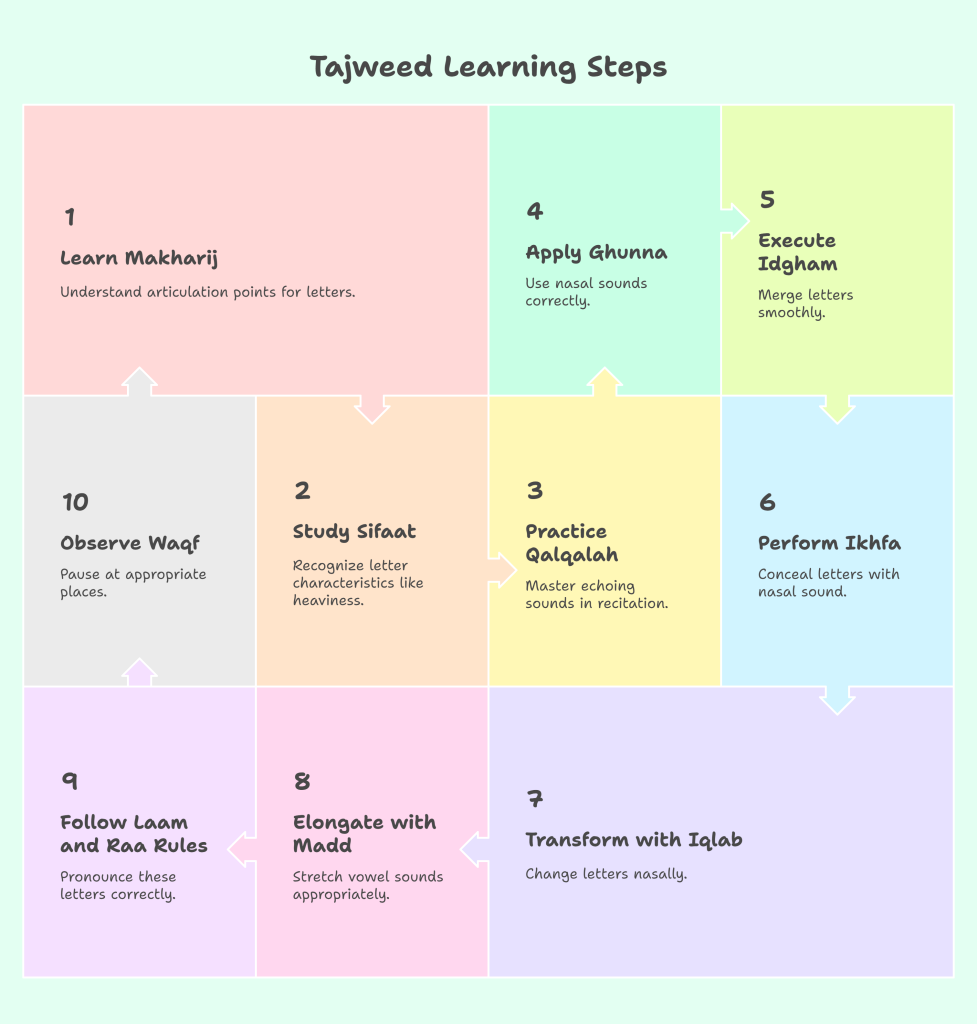
Learning Tajweed may sound overwhelming at first, but the truth is — you only need to start with the basics. These essential rules help you recite the Quran as it was revealed, with accuracy and respect.
Whether you’re just starting or brushing up on your recitation, these 10 beginner-friendly Tajweed rules will give you a strong foundation.
✅ 1. Makharij (Points of Articulation)
Every Arabic letter comes from a specific part of the mouth, throat, or nose. This is known as Makharij.
📌 Why it matters: Mispronouncing a letter can completely change the meaning of a word.
Example:
- ق (Qaf) vs. ك (Kaf) — Qalb (heart) vs. Kalb (dog)
🎯 Start by learning where each letter originates — there are 17 articulation points in total.
✅ 2. Sifaat (Characteristics of Letters)
Sifaat refers to the qualities or attributes of each letter — such as heaviness, softness, or echoing.
📌 Why it matters: It shapes the sound and rhythm of recitation.
Common attributes include:
- Hams (whispering sound)
- Qalqalah (echo or bounce)
- Tafkheem (heavy) vs. Tarqeeq (light)
✅ 3. Qalqalah (Echoing Sound)
Qalqalah occurs when certain letters are pronounced with a bouncing sound — especially at the end of a word.
Qalqalah letters: ق ط ب ج د (grouped as قطب جد)
Example:
- وَتَبَّ (wa tabb) — the ب is pronounced with a slight echo.
🎯 Tip: Practice Qalqalah by reciting short verses with a teacher or app.
✅ 4. Ghunna (Nasal Sound)
Ghunna is the nasalization of sound — lasting for about 2 beats. It mainly applies to:
- نّ (Noon Mushaddadah)
- مّ (Meem Mushaddadah)
Example:
- إِنَّا (Inna) — nasalize the نّ for two counts.
🎧 Listen to reciters to get used to the sound and length.
✅ 5. Idgham (Merging Letters)
Idgham means to merge one letter into another, so they blend as one sound. It applies when Noon Saakin or Tanween is followed by specific letters.
There are two types:
- With Ghunna (e.g., ي ن م و)
- Without Ghunna (e.g., ل ر)
Example:
- مِنْ رَبِّهِمْ → pronounced as مِرَّبِّهِمْ
✅ 6. Ikhfa (Concealment)
Ikhfa means to partially hide the Noon Saakin or Tanween, creating a light nasal sound — not full merging, not full pronunciation.
Applies to: 15 letters like ت, ث, ج, د, ذ…
Example:
- مِنْ ثَمَرَاتٍ — the ن is softened and nasalized.
🎯 Ikhfa lies between clear and merged sounds. Practice helps!
✅ 7. Iqlab (Changing Letter)
Iqlab occurs when Noon Saakin or Tanween is followed by ب. The ن is turned into a م sound with a nasal tone.
Example:
- مِن بَعْدِ → pronounced مِم بَعْدِ
Tip: Gently close your lips to make the م sound flow.
✅ 8. Madd (Elongation)
Madd means to stretch a vowel sound for a certain number of beats (harakahs). Some elongations are 2 counts, others go up to 4–6.
Types of Madd include:
- Madd Tabee’i – natural stretch (2 counts)
- Madd Munfasil/Muttasil – connected/disconnected (4–5 counts)
Example:
- قَالَ → stretched Qaala for 2 counts.
✅ 9. Rules of Laam and Raa
These two letters have special pronunciation rules based on the letters before or after them.
- Laam in “Allah” is heavy if preceded by a Fatha or Dhamma
- Example: “Allahu Akbar”
- Raa can be heavy or light depending on surrounding vowels
Example:
- رَبَّنَا (Rabbanaa) — heavy R
- فِرْعَوْنَ (Fir’awn) — light R
✅ 10. Waqf (Stopping Rules)
Waqf rules govern where and how to stop while reading the Quran. Stopping at the wrong place may alter the meaning.
Common stop symbols in the Quran:
- م = Mandatory stop
- ط = Preferred stop
- ج = Permissible stop
- لا = Don’t stop
🎯 Learn how to pause without breaking meaning. Listen and repeat from expert reciters.
🌟 Bonus Tip: Use Color-Coded Mushafs
Many Quran copies now include color-coded Tajweed rules, which:
- Highlight rules directly on the page
- Help beginners remember and apply rules visually
Look for “Tajweed Quran” or “Color Coded Mushaf” online or in Islamic bookstores.
🙋♀️ FAQs: Tajweed Rules Simplified
Q1: Should I memorize all Tajweed rules at once?
No. Focus on applying one rule at a time, starting with Makharij and basic elongation.
Q2: Can I learn Tajweed without knowing Arabic?
Yes. Tajweed is mostly about pronunciation, not vocabulary or grammar.
Q3: How can I practice Tajweed daily?
- Recite 5–10 verses with a Mushaf
- Listen to a reciter and repeat
- Record yourself to check your pronunciation
Q4: Is making a Tajweed mistake a sin?
Not at all — especially for beginners. What matters is your effort to improve.
🌱 Final Words: Tajweed Is a Journey, Not a Test
Start slow, stay consistent, and seek guidance. Each rule you learn brings you closer to the way the Quran was meant to be recited — with beauty, care, and love.