Want to understand the Quran in its original language? Follow this simple guide to start learning Quranic Arabic—even with zero background.
🌟 Introduction: Why Learn Arabic for the Quran?
The Quran was revealed in Arabic — a language rich with depth, precision, and beauty. While reading a translation is helpful, nothing compares to connecting with the Quran in its original form.
If you’re a non-native Arabic speaker, the idea of learning the language may seem difficult. The good news? You don’t need to become fluent to start understanding the Quran.
This guide will walk you through a step-by-step plan to begin learning Quranic Arabic in a way that’s achievable, rewarding, and spiritually uplifting.
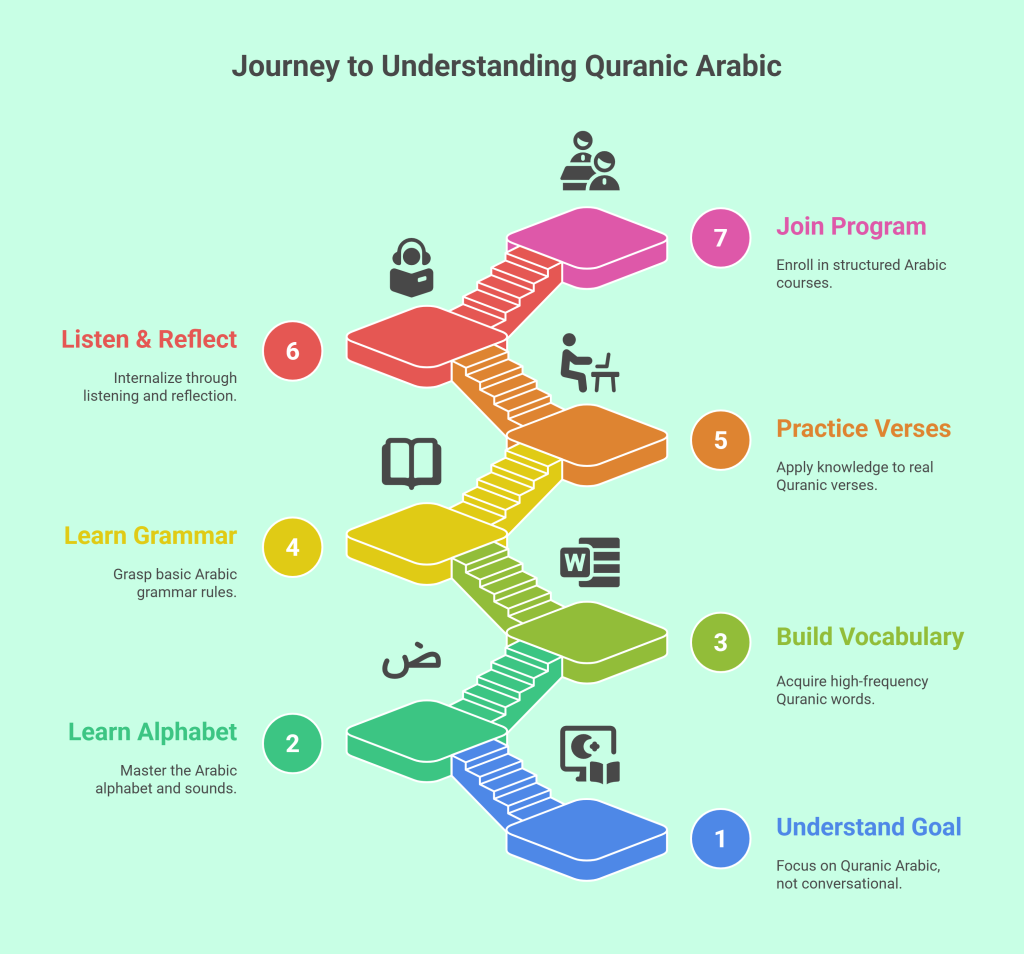
🟩 Step 1: Understand the Goal — Quranic Arabic, Not Conversational Arabic
Arabic has many forms:
- Classical Arabic: Language of the Quran
- Modern Standard Arabic (MSA): Used in news, formal writing
- Dialectal Arabic: Spoken in different Arab countries
🎯 Your focus should be on Quranic Arabic, also called Fus’ha (classical). It’s what the Quran, Hadith, and early Islamic texts are written in.
🟩 Step 2: Learn the Arabic Alphabet and Sounds
Start with the Arabic alphabet — 28 letters with distinct shapes and sounds.
🧱 What to focus on:
- Letter names and shapes
- Vowel marks (Fatha, Kasra, Damma)
- Sukoon, Shaddah, Madd
- Pronunciation (Makharij)
📱 Tools to help:
- Apps: Alif Baa, Duolingo Arabic (for basics), Learn Quran Tajwid
- Videos: “Arabic alphabet for Quran beginners” on YouTube
- Books: Gateway to Arabic series, Noorani Qaida
🟩 Step 3: Build Core Quran Vocabulary (Most Frequent Words)
You don’t need to learn thousands of words. Start with high-frequency Quranic words. In fact:
- Just 300 root words make up over 70% of the Quran!
🔤 Focus on:
- Pronouns (هو، هي، أنت)
- Key verbs (قال، علم، عبد)
- Common nouns (الله، رسول، كتاب)
- Prepositions (في، على، من)
📚 Great resources:
- Understand Quran Academy (they teach by frequency)
- Quranic app (fun, spaced repetition)
- Word lists like “80% Quran Vocabulary”
🟩 Step 4: Learn Basic Arabic Grammar (Nahw & Sarf)
To make sense of verses, you need some grammar:
- Nahw (Syntax) – sentence structure
- Sarf (Morphology) – root system, verb forms
🧠 Start with:
- Noun-adjective agreement
- Definite vs. indefinite (الكتاب vs. كتاب)
- Basic verb conjugations (past, present, imperative)
- Subject–object structure
🎯 Suggested beginner books:
- Madinah Arabic Book 1 by Dr. V. Abdur Rahim
- Arabic Through the Quran by Alan Jones
- Arabic Grammar Made Easy
🟩 Step 5: Practice with Real Quranic Verses
Apply what you learn directly on Quranic text. This builds both skill and motivation.
👣 Beginner-friendly Surahs:
- Surah Al-Fatiha
- Surah Al-Ikhlas, Al-Falaq, An-Naas
- Surah Al-Asr, Al-Kawthar
🔍 Try this:
- Read the verse
- Break it down word by word
- Translate and reflect on it
- Listen to the verse and repeat after
🟩 Step 6: Listen, Repeat, and Reflect
Listening to the Quran helps you:
- Internalize vocabulary and structure
- Improve pronunciation
- Develop spiritual connection
🎧 Suggested reciters for learners:
- Maher Al-Muaiqly
- Husary (slow and clear)
- Mishary Alafasy
📝 Combine with journaling:
- Write verses you studied
- Translate in your own words
- Reflect: What is Allah teaching me here?
🟩 Step 7: Join an Arabic or Quran Language Program
Structured courses help you stay consistent. Many programs are designed specifically for non-native speakers.
🔹 Online programs to consider
💡 Choose a course that emphasizes:
- Vocabulary + grammar + Quran practice
- Guided instruction and live feedback
- Flexible schedules
🙋♀️ FAQs: Learning Arabic for the Quran
Q1: How long does it take to understand the Quran in Arabic?
If you study regularly (30 mins a day), you can start understanding basic verses in 3–6 months. Deeper understanding takes time, but consistency pays off.
Q2: Do I need to be fluent in Arabic to understand the Quran?
No. Many non-Arabic speakers understand Quranic meanings without fluency. Focus on Quran-specific vocabulary and grammar.
Q3: Can children also learn Quranic Arabic?
Absolutely. Many programs offer child-friendly Arabic lessons. Learning young makes it easier to absorb.
Q4: Should I learn Modern Standard Arabic (MSA) too?
MSA is useful if you plan to read Islamic books or watch Arabic media, but for Quran, stick to classical/Fus’ha Arabic first.
🌱 Final Words: Small Steps Lead to Big Rewards
Learning Arabic to understand the Quran is one of the most blessed journeys you can take. Don’t worry about perfection — just keep moving forward. With each word you understand, your heart will feel closer to Allah.
Remember: You’re not just learning a language. You’re learning to talk to your Creator.