As a new Muslim who wants to learn Quran you need to know what to do if you cannot read Arabic and how long it takes. There are a lot of guides that tell you the same three things: start with Al-Fatiha, find a good teacher, and be consistent. It’s right but not enough. That is what this guide actually covers.
in this guide you will learn how to learn Quran online with a practical steps that will help you how to start and how it works and how to find a Quran teacher online…
Before we start you have to know that there is a difference between a beginner who can already read Arabic script and a beginner who cannot. The path forward is different for each
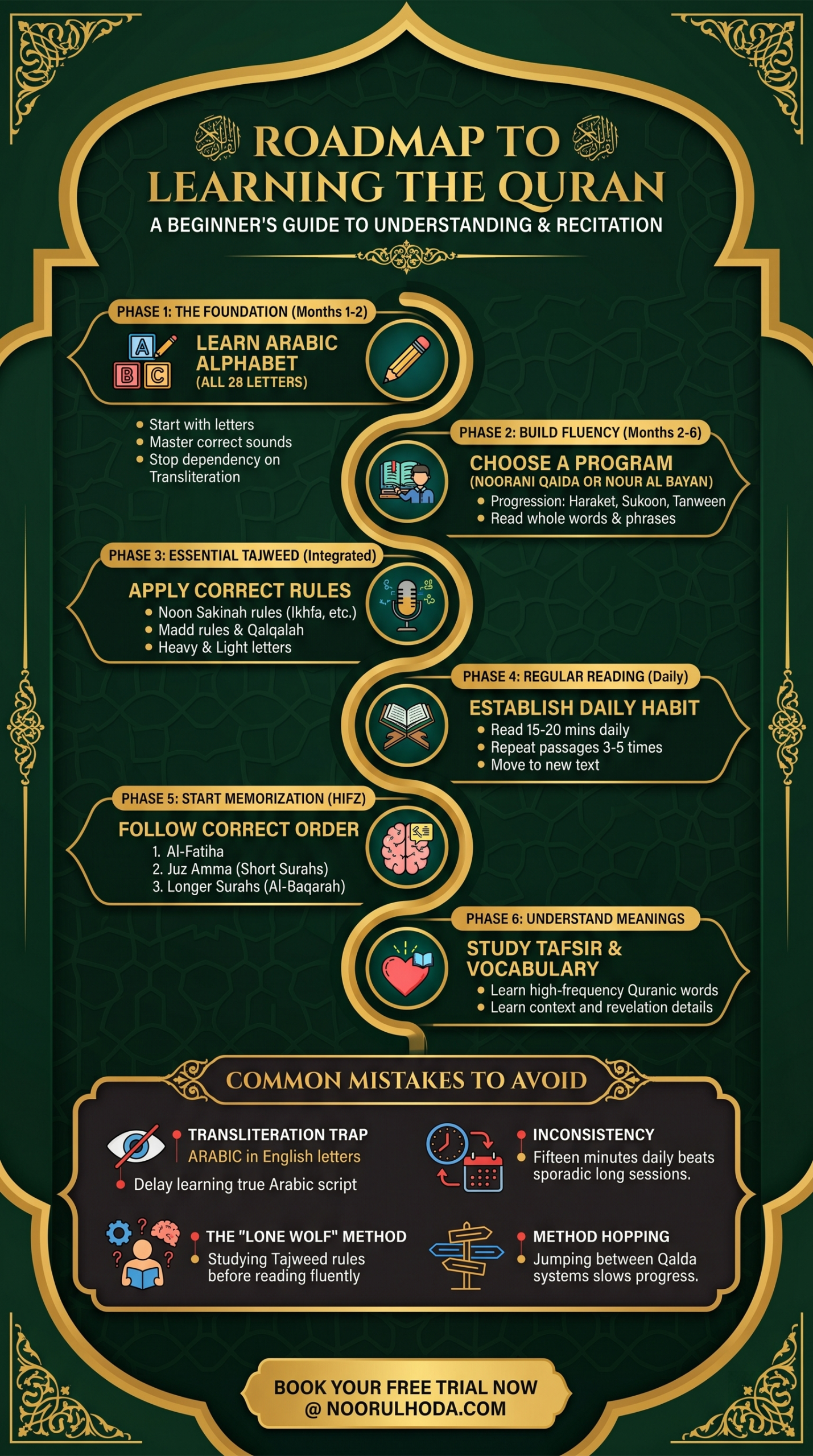
If you cannot read Arabic yet, your first task is not Quran memorization or Tajweed. It is learning to read. Trying to memorize or recite the Quran without being able to read Arabic is possible — people do it phonetically — but it creates problems later. You become dependent on transliteration (Arabic written in English letters), which trains your eyes and brain on the wrong input. When you eventually need to read from a Mushaf, you are essentially starting over.
Start with the letters. All 28 of them. This takes two to four weeks for most adults with regular practice. It is the only genuine prerequisite for everything else.
If you can already read Arabic — even slowly, even haltingly — you can skip ahead to the reading fluency stage below.
Build Your Foundation
Once you know the letters, the next stage is learning to read Arabic text accurately with correct sounds, and correct vowel marks. This is where most beginners need structured guidance rather than self-learning. Those who decide to learn Quran without a foundation at this stage almost always have to restart later.
Noorani Qaida Program
phonics-based method that takes you from individual letters through connecting letters then:
- vowel marks (harakat)
- Sukoon
- Tanween
- Shaddah
- Madd
It builds in a precise sequence so that each skill is solid before the next is introduced. By the end of a full Noorani Qaida course, you can read any Arabic text including the Quran with reasonable accuracy.
Nour Al Bayan
Follows a similar progressive structure and is widely used in Egypt and across the Arab world for children and adult beginners alike. It is slightly faster-paced on reading short Quranic phrases, which motivates learners by connecting practice directly to the actual text they are working toward.
Either method works. What matters is that you go through one of them completely, with a qualified Quran teacher online correcting your pronunciation in real time. Self-teaching these methods from YouTube is possible but slow — mispronunciations that a teacher catches in the first week can otherwise become habitual over months.
At Nour Ul-Huda, this stage is covered in both our Noorani Qaida course and Nour Al Bayan course. Both run as live one-on-one sessions with certified teachers. Students complete this stage within three to six months depending on practice between sessions.
Learn Basic Tajweed Rules
Here is where a lot of beginners get confused. Tajweed sounds intimidating because of Arabic terms and multiple categories of rules about when to start. Let me clarify the practical reality.
You do not need to master Tajweed before you can read the Quran. What you need is enough Tajweed to read correctly — which means knowing the basic rules that affect nearly every verse:
- The letters of Ikhfa, Idgham, Iqlab, and Izhaar (the Noon Sakinah and Tanween rules)
- Madd rules — when to extend a vowel and for how long
- Qalqalah — the echo sound on certain letters
- Shaddah — the doubled consonant
- The difference between heavy (mufakhkham) and light (muraqqaq) letters
These are not optional refinements for advanced students. They are basic rules that change pronunciation — and in some cases, meaning — in everyday Quranic reading. A teacher who teaches you to read without these is teaching you to read incorrectly, regardless of how fluent you become.
The good news: these core rules are teachable within a few months alongside reading practice. They do not require a separate multi-year study program before you can open the Quran. Our Learn Quran Reading course integrates Tajweed basics directly into the reading curriculum so you are learning them in context rather than as an abstract exercise.
Read the Quran Regularly and Build Fluency
This step is the one most people skip too early and most people abandon too quickly.
Reading fluency — the ability to read the Quran at a reasonable pace without stopping to decode every word — comes from volume. There is no substitute. You need to read a lot of Arabic text repeatedly, The same way a child learning to read English becomes fluent by reading dozens of books, not by studying phonics rules for three years.
Reading practice should be at a minimum: fifteen to twenty minutes of actual reading daily. Not listening and Not watching someone else recite. Reading with eyes on the page, sounding out words, and moving through the text.
A practical structure
Read the same passage three to five times in one sitting, then move forward. Repetition within a session builds automatic recognition of common words and patterns. The most frequent words in the Quran appear hundreds of times. Once your brain recognizes them without decoding, your reading pace jumps noticeably.
If you are also working toward memorization, this reading practice and your Hifz work reinforce each other. Students in our Quran Memorization Program who maintain separate daily reading practice consistently retain verses better than those who focus exclusively on the memorization sessions.
Start Memorizing In the Right Order
To Learn Quran you have to start with Al-Fatiha and Juz Amma (30th part contains short surahs most commonly recited in prayer). This is sensible. These are the parts of the Quran you will use most immediately in your daily salah, and that practical connection keeps motivation high.
The standard progression for a beginner working toward Hifz:
- Al-Fatiha first as it contains Seven verses and recited in every rak’ah.
- The short surahs of Juz Amma,including:
- Al-Nas
- Al-Falaq,
- Al-Ikhlas
- Al-Masad
- Al-Nasr and so on.
- Al-Baqarah lasts as it is the longest surah and typically the capstone of a serious memorization program.
There is a reason traditional halaqaat (memorization circles) follow this order. The short surahs of Juz Amma are easier to hold in memory. They also build confidence. Completing a surah, however short, feels like real progress. That feeling matters more than people admit.
Quran Memorization without understanding is work but it’s hard to keep and needs more effort — but memorization with even basic comprehension is stickier and more personally meaningful. Pairing Hifz work with basic Arabic vocabulary study, or with a Quran Tafsir course as you advance, makes you understand the meaning, not just the sounds.
Understand What You Are Reading
This stage catches most beginners off guard because nobody mentions it upfront. You work for months on fluency and then you realize you’re reciting a language you don’t understand. That’s a real problem worth solving.
The Quran’s vocabulary has a core that repeats constantly — scholars estimate that around 100 high-frequency words account for roughly half of everything in the text. Getting those 100 words into your active memory changes the experience of reading almost immediately. You start catching phrases you recognize, tracking familiar roots, following the rhythm of meaning rather than just sound.
For depth beyond vocabulary, a Quran Tafsir course is the practical next step. Because Tafsir tells you why a verse says what it says including the occasion of revelation and the grammatical choices, even the connection to other parts of the Quran. This is something translation alone can’t do. That context transforms recitation.
Most people who recite Surah Al-Kahf every Friday couldn’t explain the link between its four stories or why those stories address what they address. Once you can, the surah recites differently. That’s the point of this stage — not more information, but a different kind of presence with the text.
The Mistakes That Keep Beginners Stuck
These patterns come up constantly. Knowing them in advance saves months of frustration.
Transliteration is the first trap. It feels helpful early on — and for the first week or two of learning letters, it is. After that, every hour you spend reading Arabic written in English letters is an hour your eyes aren’t training on actual Arabic script. The longer you stay there, the harder the transition becomes. Drop it earlier than feels comfortable.
Inconsistent practice is the second. Fifteen minutes every day beats ninety minutes on Sunday. This isn’t a motivational point — it’s how memory actually works. The brain consolidates what it retrieves repeatedly over time, not what it absorbs in one long sitting. Short, daily contact with the Quran compounds. Sporadic sessions don’t.
Studying Tajweed rules before you can read. Some students spend weeks on terminology — Ikhfa, Idgham, Qalqalah — without being able to read a page of the Quran fluently. The rules only become real when you’re applying them to actual text. Learn them in context, not before you have context.
Jumping between methods. Noorani Qaida, Baghdadi Qaida, Nour Al Bayan — they all get you to the same place. Switching because progress feels slow usually just means starting over. Finish what you started.
Trying to go it alone. Arabic pronunciation is nearly impossible to self-correct. Errors that feel right to your own ear are exactly the ones that stick longest. A live Quran teacher online hears what you can’t hear yourself — and fixes it before it becomes habit.
How to learn Quran Online | how lessons work?
Simpler than most people expect. A live session is a video call — Zoom, Google Meet, whatever works. You recite, the teacher listens. If you’re reading from a screen, you share it. If you’re using a physical Mushaf, you hold it up. Corrections happen as you go, not at the end.
That’s the part YouTube can’t do. A video can’t tell you your ‘ain sounds like an alif, or that your Ikhfa is bleeding into Idgham. A live teacher can — and does, every session.
When you learn Quran online with a certified teacher at Nour Ul-Huda, Quran lessons run 30–45 minutes, one-on-one with a certified teacher. Scheduling is flexible across time zones. There’s a free trial class — no commitment, no pressure — so you can see how it feels before enrolling.
How Long Does It Take?
Depends what you mean by “learn.”
Fluent reading with basic Tajweed — most students get there in 6 to 18 months of regular sessions. Juz Amma memorized — typically 6 to 12 months at a moderate pace. Full Quran (Hifz) — 2 to 5 years, depending on your age, your starting level, and how much daily time you put in.
Understanding what you’re reading? That one doesn’t have an end date. Even scholars who’ve spent their lives in Quranic study will tell you the text keeps revealing things. The goal isn’t to finish — it’s to go deeper every year than you did the year before.
Where to Start learning Quran Online
Complete beginner — No Arabic reading yet: start with the Noorani Qaida or Nour Al Bayan course.
Can read Arabic but want to improve fluency and Tajweed: Learn Quran Reading course.
Ready to memorize: Quran Memorization Program.
Want to understand meanings and context: Quran Tafsir course.
Want broader Islamic knowledge alongside Quran — aqeedah, fiqh, seerah: Islamic Studies course.
All one-on-one, all live, all online. Your first class is free — no commitment required. When you learn Quran online with the right teacher and the right structure, progress is consistent and measurable from week one.